
(This is taken from the author’s presentation for another symposium on the general issue of perception. Various talking points have been merged to create this ad-hoc essay. The stream of consciousness may not be great, but recreating the actual verbal arguments made from the presentation over 3 years ago is impossible anyway.)
First published in 1959, Robert A. Heinlein’s Starship Troopers is a military science fiction novel in which the personal accounts of Juan “Johnny” Rico, a young military recruit, are detailed, the plot later taking a turn to convey a stratocratic governance system with its justifications and utilitarian perception of value that is heavily anthropocentric. One of the author’s most influential works, the novel is set in a future society where Earth is engaged in a war against alien species, and through the protagonist’s experiences; themes of militarism, duty, citizenship and the nature of war are explored.
As expected, most of the fighting, on paper, is done by spaceship but one cannot expect to grab ahold of a spacefaring civilization only through outer space combat, somebody has to ‘go in’. This is exactly where Mobile Infantry comes into play–an elite military unit composed of highly trained and exceptionally motivated soldiers with advanced powered armor suits. Rico, the protagonist, undergoes training and serves in the unit during a war against the Arachnids.
This presentation will utilize the dialogues that occur between Mr. Dubois and the protagonist as a tool to iterate the differences of viewpoints and perception especially those concerning governance and leadership, sense of duty, the concept of citizenship. Not foregoing, of course, value attached to, or attained by, mankind and non-humans alike.
The sections concerning military training, and operations are omitted for the sake of this presentation as they don’t serve to deepen the perceptual concept, even though quite agreeably they are a key part of the novel’s content.
Perception
Known as the processing and later understanding of information received through the sensory faculties of living beings, perception involves vision, sound, physical texture, taste, and smell especially for humans, though it is not exclusive to them as other life forms too possess sensory organs and thus can perceive their surroundings, of course, to a much simpler extent. While it is unique to each person, it’s heavily influenced by collective factors, and as a requirement of this assertion, the likely possibility of a collective (or a society) forming a higher perception from which singular perceptions are altered becomes important to consider, as in the example of citizens of different countries viewing events of worldwide importance only as it conforms to their collective perceptions, taking only what matters to them.
“The filter that helps interpret what one experiences, turning it into meaningful thoughts, memories, and emotion… a storyteller, weaving narratives from the threads of sensory input…”
Value
In its largest terms, value can be regarded, hence valued, as the salience of any object, be it real or virtual, as it pertains to the beholder. Then this proverbial object is evaluted, that is, given importance in accordance with his inherent nature.
What must be understood here is the fact that value affects perception in an irreversible way, much before any other rhetorical device may intervene.
The apparel, brands one purchases from, one’s position at work determines how a person will be perceived by others, especially from how well they match with widely accepted cultural norms and past experiences. While sounding much similar to prejudice, it is actually compatible with more complex instances, because those past experiences form a collective history when talking about a society.
Within the novel, value is considered from a top-down approach. Value is secured through each individual in conjunction with the education system. This system is utilitarian to a fault but nationalistic and antrophocentric to an extent that nears irrationality.
The author also employs an extremist narrative when relative value is to be discerned, earning him the title of the ‘dean of science fiction writers’, and the pioneer of the sub-genre of hard science fiction due to his strict adherence to scientific accuracy and emphasis on logical arguments in plots.
In sum, in the novel, value isn’t predetermined, but rather earned through one’s deeds, much reminiscent of tribal ideals.
Some excerpts that demonstrate how utalitarian ideals work in the novel are listed below, these have been paraphrased and abridged while in presentation, but here are the originals:
“He had been droning along about “value,” comparing the Marxist theory with the orthodox “use” theory.
Mr. Dubois had said, “Of course, the Marxian definition of value is ridiculous. All the work one cares to add will not turn a mud pie into an apple tart; it remains a mud pie, value zero.
By corollary, unskillful work can easily subtract value; an untalented cook can turn wholesome dough and fresh green apples, valuable already, into an inedible mess, value zero.
Conversely, a great chef can fashion of those same materials a confection of greater value than a commonplace apple tart, with no more effort than an ordinary cook uses to prepare an ordinary sweet.
These kitchen illustrations demolish the Marxian theory of value — the fallacy from which the entire magnificent fraud of communism derives — and illustrates the truth of the common-sense definition as measured in terms of use.”
And on another tangent, the novel touches upon the roots of market value:
“If you can’t listen, perhaps you can tell the class whether ‘value’ is a relative, or an absolute?”
“An absolute,” I answered, guessing.
“Wrong,” he said coldly.
“‘Value’ has no meaning other than in relation to living beings. The value of a thing is always relative to a particular person, is completely personal and different in quantity for each living human
‘Market value’ is a fiction, merely a rough guess at the average of personal values, all of which must be quantitatively different or trade would be impossible.
There is an old song which asserts that ‘the best things in life are free.’ Not true! Utterly false! […]people had been led to believe that they could simply vote for whatever they wanted… and get it, without toil, without sweat, without tears.“
But even with all the communal narrative, so long as one is part of the pack, and not a member of those who would be called the ‘enemy’, the individual too does matter:
“Are a thousand unreleased prisoners sufficient reason to start or resume a war?”
I didn’t hesitate. “Yes, sir! More than enough reason.”
“More than enough. Very well, is one prisoner, unreleased by the enemy, enough reason to start or resume a war?”
I hesitated.
“Come, come, Mister! […]starting a war is much more serious than paying a trifle of money. Wouldn’t it be criminal to endanger a country — two countries in fact — to save one man? Especially as he may not deserve it? Or may die in the meantime? Thousands of people get killed every day in accidents… so why hesitate over one man? Answer!”
This brings us to another key point of the novel that affects how people are valued within a society, and that is the general ideology of the ruling class. And with that I present to you, stratocracy.
Stratocracy
A form of government where military or military officials hold the ultimate power and authority.
The military plays a dominant role in decision-making and governance in a stratocracy. Military leaders have control over political and administrative matters, shaping the policies and direction of the state. Characterized by a strong emphasis on military power, discipline, and hierarchy, it can exist as a separate system or be incorporated within another political system, such as an autocracy or a dictatorship.
Even with all the connotations of dictatorship that it gives rise to, we see it as a complimentary to the republic in the novel. There are three key pillars that go into making this system stand upright.
The Three Pillars of Stratocracy
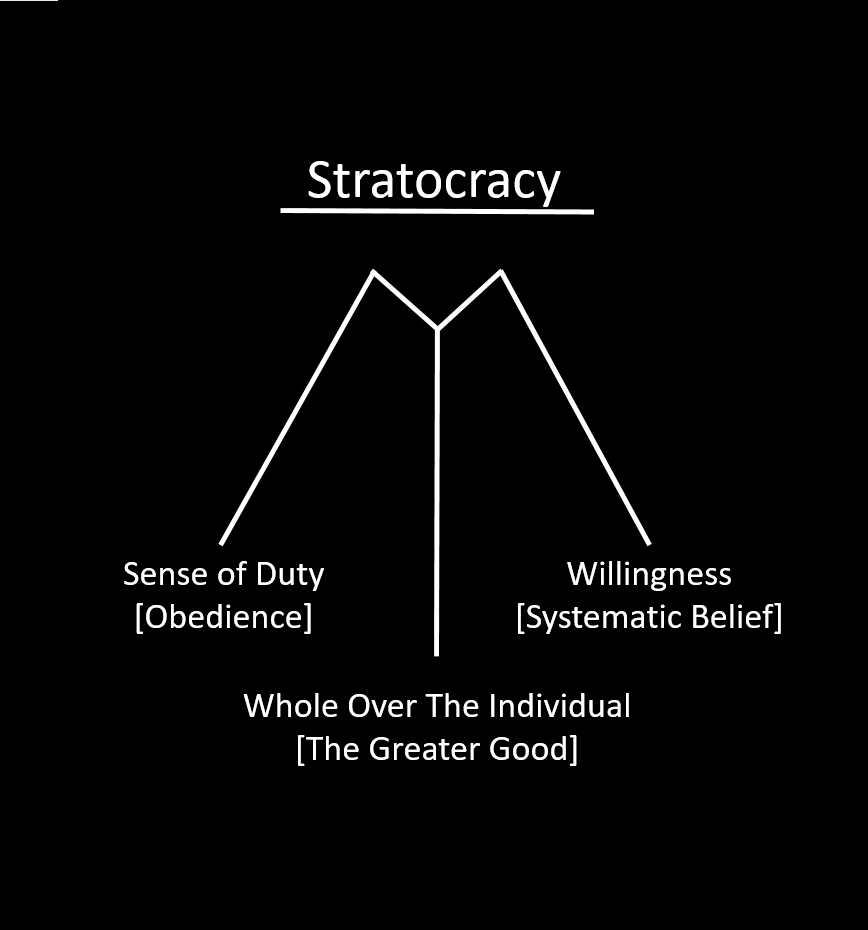
These pillars do not exist naturally in the sense of the word, it is the compounding the novel brings that creates this structure. While not necessarily adressed in the novel, an urge to answer for duty has been a thing many cultures desired to pass down their generations.
Putting ahead the welfare of many isn’t a new concept for many, but one has to really think to whose detriment this takes place. When a governing body instills a sense of duty, and makes a person willing to ‘humbly’ serve the whole, it gets the ultimate citizen. This works as an insurance policy, especially for longevity and assured continuity, creating a dangerous precedent.
 AULA CONSILIOSUS