
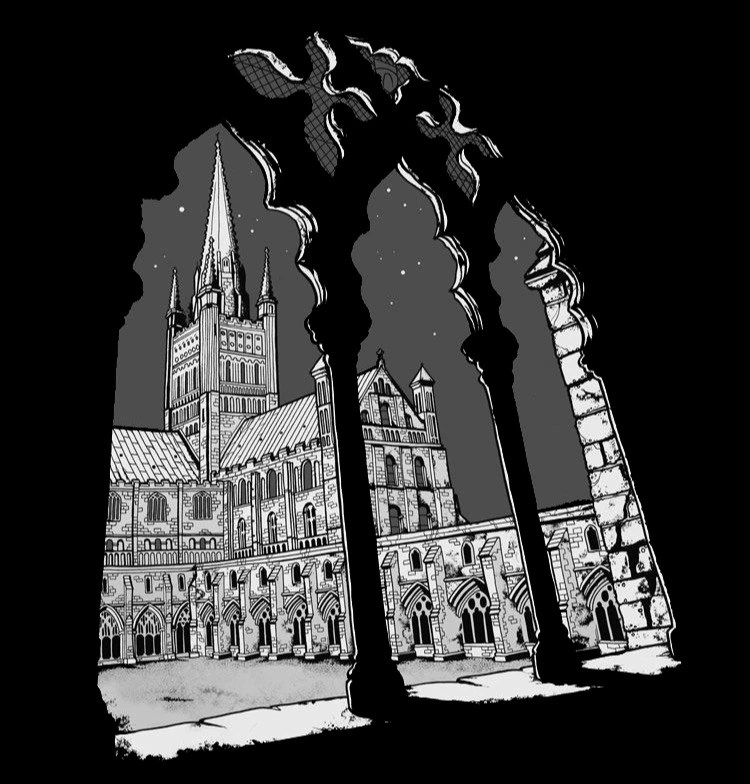
The salient ideals of the Middle Ages were feudalism, commoditization of the religion by the clergy and the rising of both Christianity and later Islam, governmental bureaucracies, the late revival of literature, and skepticism towards governing bodies leading up to the Renaissance; these ideals formed the basis on modern day Western Civilization’s understanding of the world through either the development or abandonment of these concepts as seen fit by the populace.
After the barbarian invasions from the Danube River and others, the Roman foothold in the west gradually declined to the point of Normans taking over mainland Italy. The ravaged population of Europe at that time had lost most of their holdings, farms, herd animals, and the basic necessities they needed for their very survival. Added to those calamities, plagues of pandemic scale nailed the coffin for any foreseeable future at peace.
To the East, things weren’t much better either. Eastern Roman Empire, or what is later called the Byzantine Empire had to struggle with invading barbarians, and worse yet the Sassanids, quickly becoming the bane of Byzantines’ existence just like how Parthians were to the Romans. During these bleak times, one thing was missing; and that was unity, be it in faith or by a strong leader. While strong leaders and new forms of faith with their respective derivatives weren’t in short supply, to unify these dispersed and ravaged people and impose the will of the ruler upon the populace, local governments were needed, creating feudalism.
Next came the chain of being with the rise of Christianity, and Islam wasn’t far behind. The problem with Christianity arose in the form of commoditization of the religion, utilizing the dispersed and scattered denominations to justify the clergy’s financial imperative. The clergy also used their power to emphasize more and more the importance of submission to god and the ruler, whomever it may be.
Expanding upon blind submission to God in any way necessary, this ideal was manipulated to attribute God-like specialties to the ruler by declaring him the hand, preacher, justice or whatever is popular at the time of god, thereby making the ruler look like a deity in the eyes of the populace as time went on. This did go on for some time, but in the end, people started to feel skeptical about this interpretation of faith and also societal class and grew evermore suspicious of the motives of their governments.
While some think these times and its events now belong to the dusty shelves of history, it can be safely argued that people of today are still in a feudal system of sorts today. In companies where they till the lands of their overlords and get a fraction of the profit, that is, they work hours on end doing relatively simple jobs of our modern time while businnessmen act as their regional (or, more fittingly, departmental) reeves, or chief magistrates, etc.
If not religion, the next best thing, our very data is commoditized and sold to whomever it may concern. Also, social media platforms are filled with misinformation on politics and science, governments try to control the populace through media, and the literature of the last 20 years hasn’t been the greatest of the bunch [sic!] compared to other decades after the Renaissance.
(I thought of removing the underlined section as it is a dumbfoundedly vague claim even professionals would have trouble proving. But I chose to keep it with a [sic erat scriptum] annotation, thereby owning my earlier mistakes and letting myself grow as an “aspiring”—really hate that word— writer of sorts.)
This is what we’ve accepted and abandoned, a period that gets much criticism over its cultural/social structures is replaced by the very thing it set out to change, only with a seemingly modern twist.
We accepted what we thought was modern while abandoning the seemingly “medieval” which changed virtually nothing. It is intriguing to see how the word “medieval” is used as something pejorative when objectively looking at mankind’s problems of today, our futility is indeed perpetual.
 AULA CONSILIOSUS