

Introduction
As I woke up today, a thought crossed my mind: “Why help anyone?” The answer was simple: for moral reasons, one supposedly should relieve someone in need, and there’s no legal compulsion to do so. But then another, genuinely insincere one emerged from my person’s confusion: “Why help, well, everyone?” In this query, we will be exploring the source of value attributed to living (and deceased) people and the implications of favoring either the individual or the whole over one another on this matter.
Background
Throughout the history of mankind, human beings have faced adversity from their surrounding environments as they evolved and got further and further away from the hunter-gatherer societies of the past due to the complacency that technological advancements have brought. In other words, as time passed and we got used to relying on our tools rather than pure physical resourcefulness, we went on a path that emphasized intelligence.
As of today, except for the deep sea and some obscure caverns, we have conquered most of our surroundings, no longer having the need to fear anything that is immediately nearby. Knowing this and coupling it with how we are reliant on our creations, one could easily say that people of today are worse equipped biologically to deal with survival or sustenance problems on their own.
However, this does not mean that the people of today are inherently weaker in comparison to our ancestors, it only goes to prove that people can and do still need aid in any form. Aid or help may be required by people for any number of reasons. But there’s only a finite amount of resources, so who should be valued and aided more, thereby having more diverted resources? To answer that, one would need to delve deeper into the concept of value.
Value
Value is, from a pragmatic perspective, the regard something is held to deserve; the importance, worth, or usefulness of an object. Economically thought of as monetary correspondence of importance; value in its largest terms can be regarded as the salience of any object, be it real or virtual, as it pertains to the eyes (or senses) of the beholder.
Mankind first tried to find differences in itself in contrast to animals with no perceivable sentience around them, they formed tribes and rituals due to this thought structure called the search for identity. Then they went on to differentiate themselves in their tribes and this constituted cultural break-offs, leading to first city-states and then empires. And in the eyes of a human, difference at its core is ascertained by attributed value.
Similar to class inclusions, (or the act of categorizing) attribution is an inherently relative concept to its source, and it would be only in vain to debate about the variety of humans when they are applied as the source and distributor of any attribution.
Value is derived, along with other things, from the difference, or better yet, emotionally relevant or pragmatically beneficial differing points of interest of an object. But how does one even start to value humans to each other or to something else? As can be felt by anyone reading these words, valuing humans has always proved extremely arduous. To steer clear from any shroud of confusion, a simplified thought experiment will follow.
An Experiment
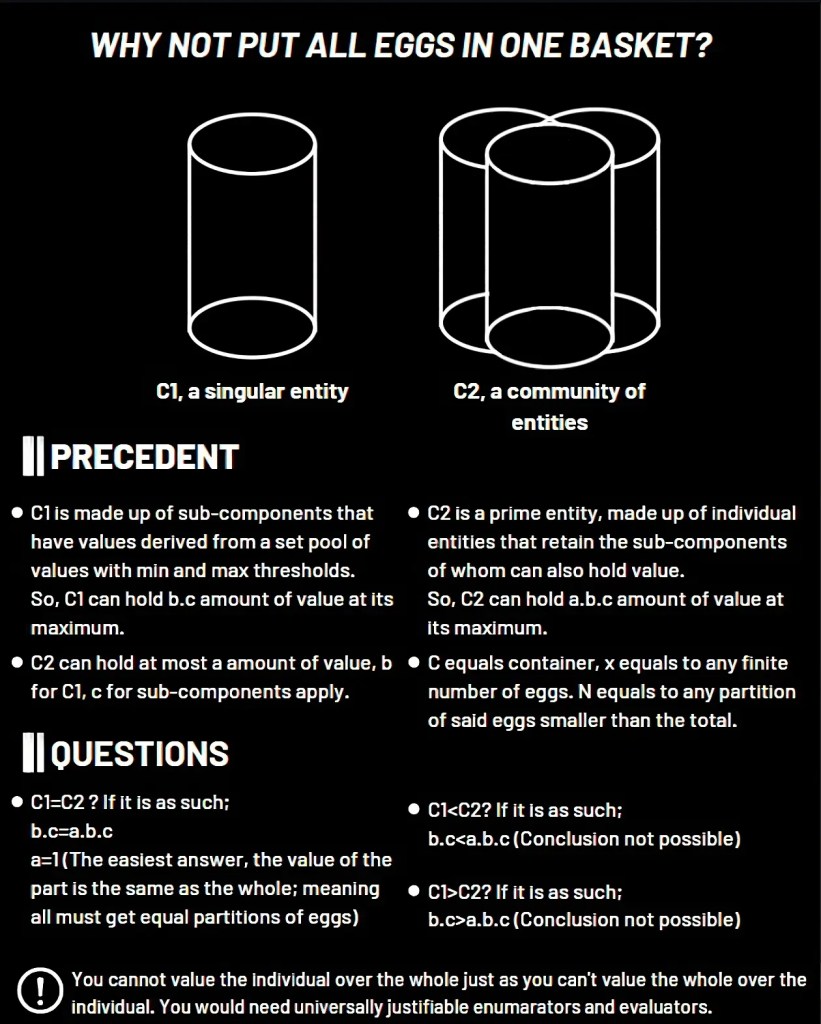
To clarify things, let us start with the definitions. All of the designations situated on the image correspond to real-life people, communities, and their attributes. The decision to name them as containers stemmed from the fact that each person contains attributes that can be valued just as the person itself, same goes for communities as well. C1 directly represents a human person, while its respective sub-components substitute personal attributes of value such as the ability to do maths at a respectable level, engage in any form of art, create things, or have authority in a field of expertise. C2 can be thought of as any group of people, it also retains personal attributes and values similar to how a society or community would. In the effort to simplify, resources or any form of aid has been replaced by eggs, this decision having been influenced by the eggs-in-basket idiom for relativity.
C1, or an individual has been declared to hold the maximum amount of value attainable as a person relative to society as “b” while the sub-components or the attributes that make up a person are identified with the letter “c”. C2 retains “b” and “c” but also brings the communities’ value to the table as “a”, hierarchically completing the structure. (Feel free to refer to the image on an additional tab at any time)
Now take a situation where resources can be spent on a patient with extremely rare conditions who needs help right now or on a far-fetched project requiring all resources available aimed to alleviate all conceivable negative human conditions; should the few be sacrificed now to reap the advantages of the future? It is an absurd question, but ordinary individual-to-group comparisons are easily examined anyway.
Favoring the project on this matter would be the same as declaring a C2 bigger than a C1. If we were to expand upon that, it could be said that favoring the community of a future time over a person who needs aid now, is the same as taking all the value and attained attributes of a community and comparing it to a person’s, hence implying that the a, b, and c of the project is also bigger than a person’s b and c.
The reverse could be argued as well by most people, but both are impossible to prove since the numeric values aren’t known, and cannot be found. Human beings are inherently viewpointed, be it emotionally or logically. This makes it clear that they are not universal, but perspective-oriented evaluators, and what is universal can only, and rarely, coincide with perspective. So long as these variables aren’t weighted, it will prove impossible to ascertain how the eggs, or resources, are to be divided.
The only premise that can be proven is when everything is declared equal, hence b.c=a.b.c (Meaning that the person’s value and their respective attributes are equal to the community, its value, and the attributes of its members). When simplified, the equation will have b.c removed from either side, and “a” will equal 1, which means the values and attributes of the excluded individual and a member of a community are one and the same. The value of the community matters not since it is the individuals that make it up in the first place, if we were to declare the excluded individual lesser, we would be declaring the community as lesser too since b times c exists on both sides. Then the only possible conclusion is that the eggs, or resources, must be divided and distributed equally.
Results
Philosophical, and psychological accounts vary, but for everyday people to have a more defined understanding; basic maths with a side of ethics does suffice. However, it is an understanding of the biased nature. After all, the heart wants what is moral while the mind yearns for a justification that is parallel with logic; it’s this that moves people to do something, not the concerned party in need or the situation itself.
Help everyone equally so long as it’s viable in its context, if it’s not, then specific analyses for the situation must be employed similar to how scholarships are determined ideally by a school board committee, its participants being from relevant fields of science. But on matters/crises of a regional or bigger scale, there can be no doubt about what should be done. The word “should” always brings an assumption, but it is a necessary one: Would you accept it if ignorance was projected upon you in your hour of need? Even if one could say so, this argument would only point to their nihilistic nature which, in aforementioned predicaments and thought experiments, brings no personal gain and thus is illogical.
Conclusion
The mathematics behind the resulting theory is painstakingly simple, but as earlier mentioned in the introduction, the moral implications of different circumstances make all the difference. Mankind has an innate sense or teaching that tells him it’s good to help people in whatever way he can, as much as possible, and no genetic trait passes on unless it’s beneficial to the species’ survival; which means the mental evolution had to have followed suit as well. Helping people is seen as important enough of a general notion that humanity has allowed it to pass on through memetics. It existed way before we coined mathematics, and this is a matter that is one with our reasoning at its core, this is why we help everyone.
 AULA CONSILIOSUS